

Overview
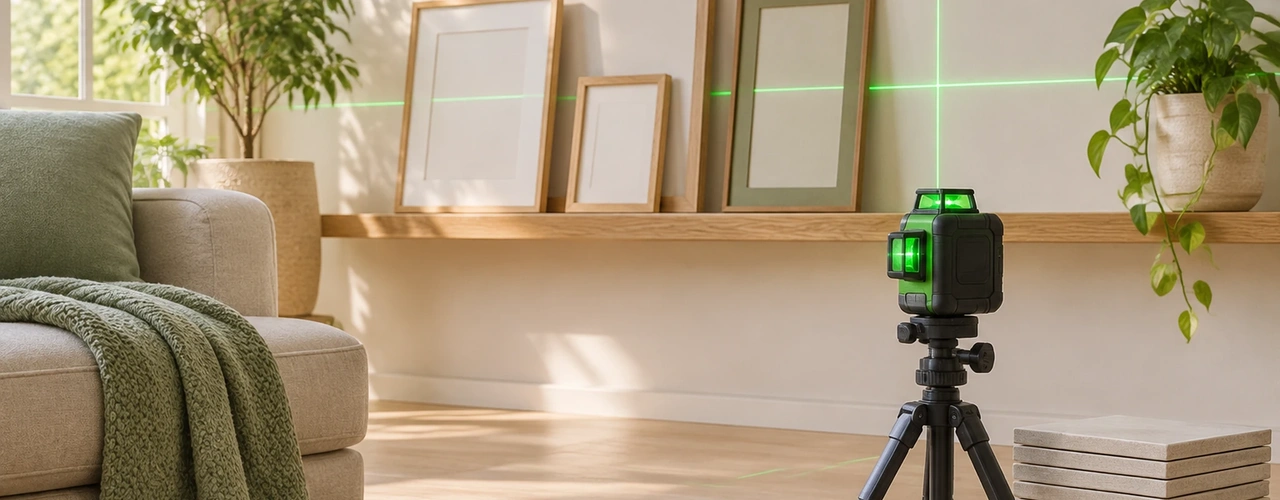
Choosing among self-leveling laser levels gets confusing when all you want is a straight row of frames, level tile courses or shelves that do not slope. A bubble level only works over short spans, while a projected line carries across a whole wall. The right tool depends on a few practical points. Beam color matters, because green is usually easier to see in bright rooms than red. Power matters too, since a built-in rechargeable battery and replaceable batteries suit different habits. Finally, look at how the tool mounts and what extras it adds, such as a clamp, extra planes or a stud sensor. This comparison weighs those criteria for typical home projects.
| Product | Rating | Best For | |
|---|---|---|---|
| Huepar 360 Self-Leveling Green Laser Level | ★ 4.6/5 (2,530) | Tiling and full-room layout | View → |
| BOSCH GLL50-20G Green-Beam Self-Leveling Cross-Line Laser Level | ★ 4.5/5 (419) | Simple, durable everyday layout | View → |
| BOSCH PRO GLL50-20 Self-Leveling Cross-Line Laser (Red Beam) | ★ 4.4/5 (808) | Indoor jobs, modest lighting | View → |
| SKIL 65 ft Green Self-Leveling Cross Line Laser Level | ★ 4.6/5 (126) | Rechargeable, clamp-mounted DIY | View → |
| BLACK+DECKER Line Laser BDL190S Auto-Leveling with Stud Finder | ★ 4.4/5 (2,796) | Hanging with stud finding | View → |
Three green 360-degree planes and a rechargeable battery cover tile, shelves and hanging in one tool. The trade-off is extra complexity if you only hang the occasional picture.
Check Price on Amazon →Huepar 360 Self-Leveling Green Laser Level

This is a green-beam cross-line laser that projects three 360-degree planes and runs on a rechargeable battery instead of disposable cells. With a horizontal plane and two vertical planes, one setup can mark guidelines around a whole room, which suits tiling a floor or wall, lining up a long run of shelves or laying out a gallery wall. Green beams are generally easier to see indoors than red ones, and the self-leveling mechanism corrects small tilts so the lines settle true without fiddling. The trade-offs are practical. It is the most feature-heavy tool in this group, so there is more to learn than with a basic two-line unit, and three planes are more capability than hanging a single picture needs.
BOSCH GLL50-20G Green-Beam Self-Leveling Cross-Line Laser Level

This is a compact cross-line laser from a well-known tool maker that projects a horizontal and a vertical line in a green beam. The manufacturer says green beams are up to four times brighter than standard red ones, which helps in well-lit rooms. It self-levels within about 3.5 degrees and carries an IP55 rating for dust and splash resistance on a job site. It runs on two AA batteries, and a lithium-ion pack is sold separately as an accessory, so there is no built-in charging. It suits homeowners who want a simple, dependable tool for hanging frames, setting shelf lines or marking tile layouts without extra planes. The trade-offs are that two lines cover less than a three-plane tool, and the optional battery adds cost if you want rechargeable power.
BOSCH PRO GLL50-20 Self-Leveling Cross-Line Laser (Red Beam)
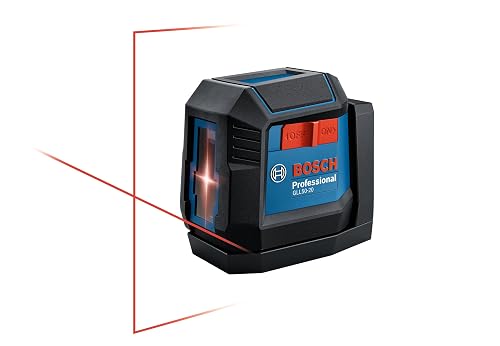
This is the red-beam version of Bosch's compact cross-line laser, projecting a horizontal and a vertical line. The manufacturer lists a working range of 50 feet and an accuracy of 5/16 inch at 30 feet. It self-levels within about 3.5 degrees, carries an IP55 rating and works in temperatures from 14 to 104 degrees Fahrenheit. It suits indoor tasks such as hanging pictures, aligning cabinets or marking shelf lines, where a red line is clearly visible in normal lighting. The honest trade-off is the beam color. Red lines are harder to see than green in bright rooms or over longer distances, and the accuracy figure is looser than some other models list. If your work is mostly indoors in moderate light, the red beam is a sensible way to save money.
SKIL 65 ft Green Self-Leveling Cross Line Laser Level

This is a green-beam cross-line laser with a stated working distance of up to 65 feet. It charges over USB, so there are no disposable batteries to replace, and it ships with a clamp for attaching the tool to a ledge, board or pipe when a flat surface is not available. The class 2 green beam is easier to see indoors than a typical red one. It suits homeowners who want rechargeable power and a clamp at a modest level of complexity, for hanging frames, setting shelves and tile layout lines. The trade-offs are that two lines cover less than a three-plane tool, and the clamp and charging cable are small parts that are easy to misplace. Buyers often mention that the clamp makes it easier to place the line exactly where it is needed.
BLACK+DECKER Line Laser BDL190S Auto-Leveling with Stud Finder

This is a compact auto-leveling line laser that combines a red laser line with a built-in stud sensor. The sensor is designed to detect wood, metal and AC wiring and shows results on an LCD display, which makes it useful for hanging shelves, mirrors or heavy frames where you also need to find a solid fixing point. It runs on two AA batteries, weighs about 1.1 pounds and comes with a two-year limited warranty. It is the most basic option here and suits occasional hanging and mounting jobs. The trade-offs are a red beam that is harder to see in bright rooms, a working range suited to small spaces rather than large rooms, and far fewer planes than a three-plane tool. For tiling or room-wide layout, other models fit better.
Conclusion
Choose this over the others when tiling or laying out several walls, because three 360-degree planes cover more of a room in one setup. The rechargeable battery also avoids buying cells. For hanging one picture, a simpler two-line tool is quicker to set up. Read More →
Choose this over the red Bosch when you work in bright rooms and want a clearer green line from a tool known for rugged build. Pick it over the SKIL if you prefer replaceable AA batteries and a brand-backed IP55 rating over built-in USB charging and a clamp. Read More →
Choose this over its green sibling when most work is indoors in moderate light and you want to spend less. Accept that the red line is harder to see in sun or across a big room, and that accuracy is listed as 5/16 inch at 30 feet. Read More →
Choose this over the Bosch models when you want USB charging and a clamp for mounting on ledges or boards, with a green beam and a long stated 65 foot working distance. It is less rugged-rated than the IP55 Bosch units and has only two lines, so skip it for full-room tiling. Read More →
Choose this over the others when your main job is hanging shelves or heavy frames and you also need to locate a stud, since the stud sensor is built in. It is the weakest choice for tile or big rooms, where a green, multi-line tool is far easier to follow. Read More →
Frequently Asked Questions
Is a green laser level better than a red one for DIY? +
Green beams are generally easier to see indoors, especially in bright rooms or over longer distances, so they suit tile and wall layout. Red models usually cost less and work well for short indoor jobs in moderate light such as hanging pictures.
Do I need a three-plane laser level for hanging pictures? +
No. A two-line cross-line laser is enough for pictures and shelves. Three 360-degree planes are most useful for tiling or laying out lines around a full room, where they save repeated setups.
What does self-leveling mean on a laser level? +
The tool has an internal mechanism that settles the lines level or plumb when you place it within its leveling range. The Bosch models here list about 3.5 degrees. Outside that range the tool will warn you, so set it on a roughly flat surface.
Should I choose rechargeable or battery-powered? +
A built-in rechargeable battery, as on the Huepar and SKIL, avoids buying cells but needs charging before use. AA-powered models like the BLACK+DECKER and Bosch are easy to refresh anywhere with spare batteries.
Can a laser level with a stud finder replace a laser level for tile? +
Not well. The BLACK+DECKER combines a stud sensor with a single line, which suits hanging and mounting. For tile, a green cross-line or three-plane model gives longer, clearer lines to follow across a floor or wall.